
The Three Currencies of Business: Why Allocation Beats Abundance
BUSINESS
Obaydur Rahman Mahin
1/22/20262 min read
People often talk about money as if it is the only real constraint in business. Pitch decks revolve around funding. Headlines celebrate valuations. Advice to founders is frequently reduced to one blunt instruction: raise more capital.
Yet anyone who has actually built something meaningful learns a different lesson early on. Money is not the only constraint and in many cases, it is not even the most important one.
In reality, founders do not manage capital alone. They manage currencies.
There are three that matter above all else: knowledge, time, and money.
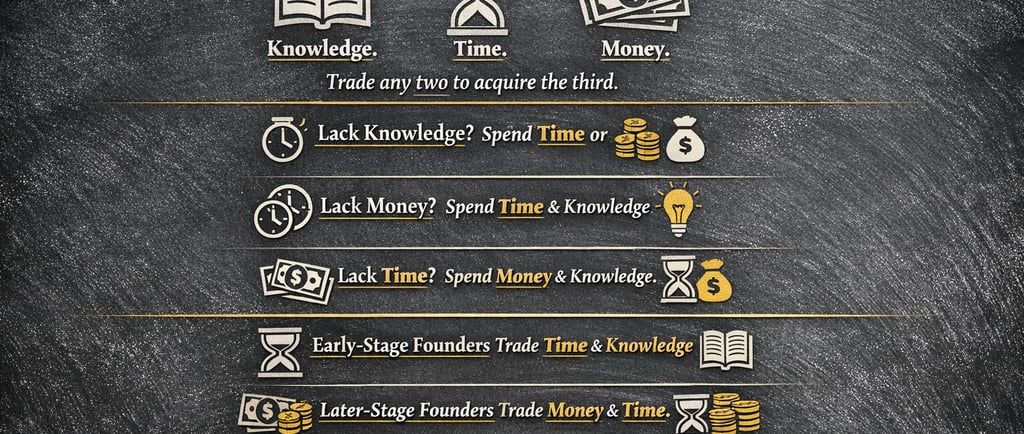
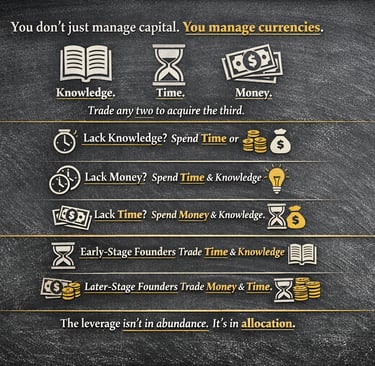
Every meaningful decision in business is, at its core, a trade between these three. You can exchange any two to acquire the third, but you can never escape the trade itself. Understanding this dynamic is one of the most underappreciated skills in entrepreneurship.
Consider knowledge first. When you lack knowledge about a market, a technology, a process you have two primary options. You can spend time learning through experimentation, reading, and iteration. Or you can spend money by hiring someone who already has that expertise. There is no third option. Every shortcut is simply a disguised trade between these same currencies.
Now consider money. When money is scarce, as it is for most early-stage founders, you compensate by investing time and knowledge. You build instead of buying. You experiment instead of outsourcing. You accept inefficiency in the short term because capital is unavailable in the present. This is not a flaw in early-stage companies; it is their defining characteristic.
Time, however, is the most misunderstood currency of all. Unlike money, it cannot be raised. Unlike knowledge, it cannot be fully transferred. When time becomes scarce, founders are forced to spend money and knowledge to protect it through delegation, systems, and organizational structure. This is often emotionally difficult, because it means letting go of tasks that once defined their identity as builders.
What changes as companies grow is not the existence of these currencies, but their relative scarcity.
Early-stage founders almost always trade time and knowledge because money is the limiting factor. They work long hours, learn rapidly, and accept uncertainty as the cost of progress. Speed comes not from efficiency, but from personal intensity.
As companies scale, the equation shifts. The organization grows faster than any individual’s ability to understand every detail. At this stage, founders increasingly trade money and time to acquire knowledge through hiring experienced operators, consultants, and specialized teams. Decision-making becomes less about doing and more about judging.
In mature organizations, the final shift occurs. Knowledge exists throughout the system, and money is available. What becomes scarce is time especially leadership attention. At this level, the most effective operators trade money and knowledge aggressively to preserve focus. They simplify, prioritize, and ruthlessly eliminate low-leverage work.
This is why scaling is not about having more of everything. Abundance alone does not create leverage. Many well-funded companies fail precisely because they misallocate their currencies spending money where time and understanding were required, or hoarding control when delegation was necessary.
The real advantage lies in allocation. In knowing, at each stage, which currency you can afford to spend and which one you must protect.
Founders who struggle often do not lack resources. They lack clarity about which trade they are making. They try to buy speed when the problem is understanding. They try to learn endlessly when the constraint is execution. Or they cling to control when the true bottleneck is time.
Business, at its core, is a continuous optimization problem across these three currencies. There is no permanent solution only better trades.
Those who master this do not chase abundance blindly. They make deliberate exchanges.
And that is where real leverage lives.