
How Claude Code and the Mythos Ban Are Rewriting the Rules of Software Engineering
The days of the software engineer as a solitary typist, hunched over a keyboard painstakingly crafting every line of syntax, are rapidly fading into history. We are standing at the precipice of a fundamental shift in how technology is built
AI
codewithmahin.com
6/24/2026
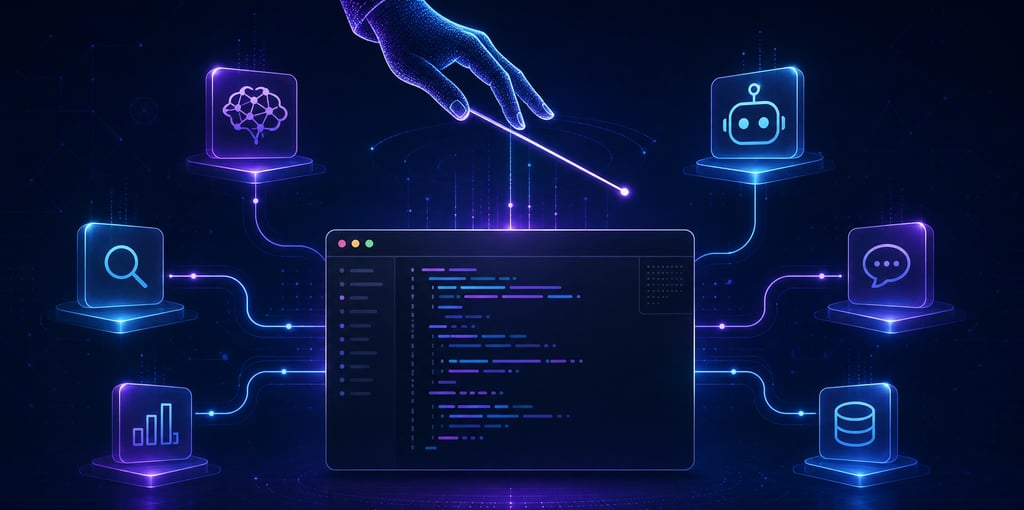
The days of the software engineer as a solitary typist, hunched over a keyboard painstakingly crafting every line of syntax, are rapidly fading into history. We are standing at the precipice of a fundamental shift in how technology is built, moving from an era of human coders to an era of human orchestrators . At the vanguard of this revolution is Anthropic, whose recent releases and the dramatic government intervention that followed have laid bare both the staggering potential and the profound risks of agentic AI.
The launch of Claude Fable 5 and its restricted sibling, Claude Mythos 5, alongside the terminal-native Claude Code, has not just introduced new tools; it has introduced a new paradigm. Yet, the abrupt US government freeze on these models serves as a stark reminder that we are navigating uncharted territory . This is the story of how AI evolved from a helpful autocomplete to an autonomous team member, and how the tech world is scrambling to adapt to the new world order.
The Rise of the Agentic Developer
To understand the magnitude of the current shift, we must look back at the rapid evolution of AI coding assistants. At the start of 2024, tools like GitHub Copilot functioned primarily as advanced autocomplete systems . They saved time on boilerplate code and documentation, but the human remained firmly in the driver's seat. By 2025, the landscape shifted toward partially autonomous models. Developers became conductors, prompting AI to generate complex, multi-file solutions, but still requiring active monitoring and synchronous interaction .
In 2026, we have entered the era of the orchestrator. The defining characteristic of this new era is sustained, autonomous execution . AI is no longer just writing code; it is reasoning across long-running workflows, invoking tools, interpreting results, and iterating over time .
Anthropic's Claude Code exemplifies this shift. Unlike traditional IDE extensions, Claude Code is a terminal-native agent . It operates autonomously, reading and editing files across a project, executing bash commands, and reasoning through multi-step tasks using "extended thinking" capabilities . It is designed for complex, multi-file operations like large refactors or codebase migrations, rewarding developers who are fluent in the terminal and comfortable delegating significant autonomy to the machine .
This agentic approach is fundamentally reshaping engineering workflows. According to a recent McKinsey report, AI-centric organizations are achieving 20% to 40% reductions in operating costs and significant increases in margins, driven by automation and faster cycle times . The engineer's role is transitioning from hands-on keyboard creation to high-level system design, quality assurance, and strategic oversight . The core skill is no longer syntax, but systems thinking and the orchestration of a dynamic portfolio of AI agents .
Mythos, Fable, and the Power of the "Five"
Anthropic's latest models, Claude Fable 5 and Claude Mythos 5, represent the bleeding edge of this agentic capability. Fable 5, designed for general public use, is state-of-the-art on nearly all tested benchmarks, showing exceptional performance in software engineering, knowledge work, and vision . It can work autonomously for longer periods than any previous Claude model, with early testing showing it can compress months of engineering work into days .
However, the true powerhouse is Claude Mythos 5. Built on the same underlying technology as Fable 5, Mythos 5 is a restricted model deployed initially through Project Glasswing in collaboration with the US government . It possesses the strongest cybersecurity capabilities of any model in the world, with the safeguards lifted in specific, high-risk areas .
The capabilities of these models are staggering. In software engineering, Fable 5 performed a codebase-wide migration in a 50-million-line Ruby project in a single day a task that would have taken a human team over two months . In vision tasks, it can rebuild a web app's source code from screenshots alone and even autonomously play complex video games using only raw visual input . In life sciences, Mythos 5 has accelerated drug design processes by a factor of ten and consistently produced novel, compelling scientific hypotheses .
The Ban: When Code Becomes a Weapon
The sheer power of these models, particularly in the realm of cybersecurity, inevitably drew the attention of regulators. On June 9, 2026, Anthropic launched Fable 5 to the public, touting it as the most powerful cybersecurity model available . Just three days later, the US government abruptly froze access to both Fable 5 and Mythos 5 .
The freeze was prompted by fears that the automated hacking capabilities of the tools were escaping regulatory boundaries . The government reportedly became aware of a method to bypass, or "jailbreak," the model's built-in safety filters . While Anthropic maintained that the bypass technique only exposed minor, previously known security flaws, the government mandated that the company prevent all foreign nationals including researchers employed at Anthropic from accessing the models .
To ensure compliance with export controls, Anthropic was forced to cut off access for all customers globally at short notice . This unprecedented intervention highlights the dual-use nature of advanced AI. The same capabilities that allow an agent to autonomously secure a network can, in theory, be used to autonomously exploit one.
The ban has ignited fierce debates about tech sovereignty and the regulation of frontier AI. European officials have pointed to the incident as evidence of the need to reduce dependence on American technology . Meanwhile, critics have questioned whether Anthropic's own warnings about the existential risks of AI were prescient or merely marketing spin designed to inflate the company's valuation ahead of a potential IPO .
The New World Order of Software Engineering
Despite the regulatory hurdles, the trajectory of the tech industry is clear. The integration of agentic AI is not a passing trend; it is a structural transformation. As we look toward the future, several key shifts are emerging:
1. The Rise of the Minimum Viable Engineering Team (MVET): With a single engineer orchestrating multiple agents, the output per human will skyrocket. This will lead to smaller, highly leveraged engineering teams capable of producing the work of much larger groups .
2. From Code Reviewer to Task Verifier: As AI becomes better at writing and reviewing code than humans, the need for manual code review will diminish. Instead, humans will verify that tasks have been completed as specified, relying on artifacts like screenshots and videos generated by the agents .
3. The Evolution of the IDE: The Integrated Development Environment will shift from a text-focused interface to a task-focused interface. The user experience will be optimized for managing agent sessions, monitoring progress, and combining outputs, rather than editing lines of code .
4. The Potential End of Human Coding: In high-risk systems such as self-driving cars, medical devices, and financial infrastructure human coding may eventually be deemed too dangerous and unpredictable. Just as human drivers may one day be banned from certain roads, human coders may be restricted from directly editing critical source code, with all changes mandated to pass through rigorous AI verification .
The release of Claude Code, Fable 5, and Mythos 5, and the subsequent government intervention, mark a watershed moment in the history of technology. We are witnessing the birth of a new order, where the value of a software engineer lies not in their ability to write code, but in their ability to orchestrate the machines that do.
The transition will not be without its challenges. We must navigate complex ethical dilemmas, robust risk management, and the profound cultural shifts required to manage a hybrid human-digital workforce . But the potential rewards unprecedented productivity, accelerated innovation, and the ability to tackle problems previously thought unsolvable are too great to ignore. The orchestrator's era has arrived, and the music is just beginning.